The Allure of Paris-Brest
by Katie Rice
I do not own a bike. Before I moved to Texas, I lived in Virginia. On my second week there, I bought a bike from a local community bike shop that refurbished junkers and sold them second hand. For $100, I got a green and silver cruiser that I rode home, wind in my hair, and then promptly left near the back shed and never picked up again. When we moved four years later, the yard had grown around it, kudzu and vines in the spokes.
I might not (yet!) be a cyclist, but I do have an appreciation for bikes and the promise they offer: independence, blood pumping, man and machine as one. I admire my husband’s pink and blue bike in our garage, the textured wheels, the sturdy welded metal. I am jealous of the energy he has when he comes home from a bike ride, his sunglasses spotted with dust and bugs.
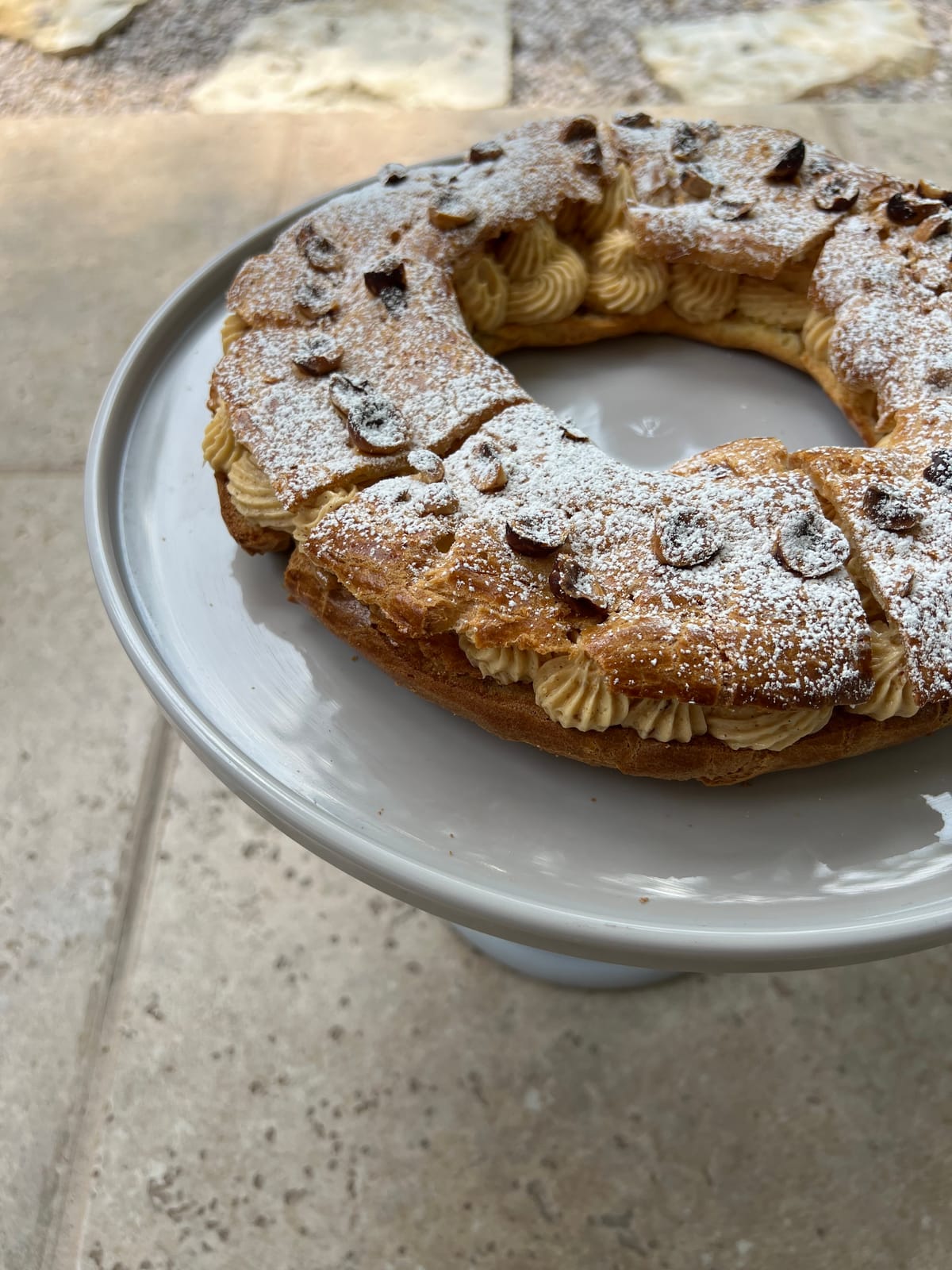
It is this same kind of appreciation for bicycles that served as the basis for the creation of the dessert Paris-Brest, a crème mousseline-filled choux pastry wheel dreamed up in 1910 by pastry chef Louis Durand to celebrate the bike race that runs from central Paris to the port city of Brest. I may not do much bike riding, but I do lots of baking. And the Paris-Brest is just the kind of baking project I like. It’s a recipe in three parts: pâte à choux, praline, and crème mousseline. If your idea of fun is spending three days cooking, whipping, and baking sugar, then maybe you’ve made this dessert, too. If not, let me explain.
First, you’ll need to make the praline, cooking sugar from white to golden liquid finally to a deep amber that will harden as it cools, encasing perfect heart-shaped hazelnuts. Then, you must turn this into a spreadable paste, blitzing the sugar you just took from solid to liquid to solid back again to something in between the two. It’s magic, really, as the blades of the food processor release all of the oils in the nuts and marry them with the sugar.
Next, you’ll need to make the mousseline. Again, this is a two step process, the kind of immersive thing I love, with an all-of-a-sudden transformation that mimics what happens to the praline paste when the oils finally take over. The base of mousseline is pastry cream, which comes together on the stove top. For minutes it will feel simply like you’re dragging a spatula through milk until in a moment it will bubble and burp and thicken. After being cooled, the pastry cream is then lightened with more butter and deepened in flavor with the praline paste.
Pâte à choux is the light, eggy dough that dreams and eclairs are made of. It also forms the basis of the Paris-Brest, but is made last because its wonder comes from its light, crisp freshness. Eggs are the key here, first cooked on the stovetop and then piped into a bike wheel and baked, where it puffs and hollows. Finally, you cut the tire in half and fill it with praline paste and mousseline, piping big swirls that ensure the top of the ring lies flat on top, then cover it all with a healthy dusting of powdered sugar and serve.
A dessert like this is enough to make me think that I should get back on a bike. Anything that could inspire something as layered with flavor and texture as a Paris-Brest, must be wonderful, right? For now, though, I make my sugary mimicries inside, my husband rides his bike in the Austin heat, and I haven’t yet bought another green and silver cruiser.
Katie Rice is the founder and editor of Sobremesa, a magazine dedicated to art and writing about food. Named after the Spanish word for relaxing at the table together after a heavy meal, the magazine is meant to be a metaphorical sobremesa for artists. Learn more about Sobremesa at www.sobremesamagazine.com or visit their booth at Lone Star Zine Fest on Saturday, October 11.
Want to contribute a guest story to the La Dolce Vélo blog about bikes or dessert? Email Heather at hb@ladolecvelosweets.com.